Hi there! This is my review on the Donner Oura R300 digital piano, one of Donner’s latest furniture style digital pianos. Now before I get started, full disclosure: I did not buy this piano, Donner was good enough to send me a review unit for my review (Thanks Donner!); but with that being said, I do promise to give you my honest opinion on the Oura R300.
Who Is Donner?
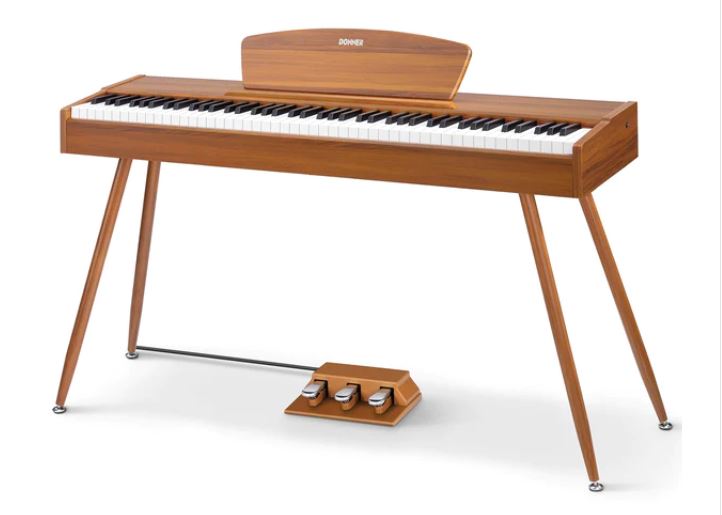
So who is Donner and why do they send product samples out to reviewers like myself? Well, if you’ve looked online or on Amazon for keyboards, digital pianos, guitars, drums or even ukuleles you have probably encountered Donner. Donner is an online only music equipment company that started out years ago making guitar pedals and accessories, and then branched out into all of these other products. As far as I know they do not sell their products in stores, only online – so since the public can’t try these out in stores, the only way for people to get any independent feedback is from reviewers like myself, so this is why Donner sends out sample products to be reviewed. I’ve previously reviewed 2 other Donner pianos, the Donner DDP-80 (another furniture style piano) and the portable Donner SE-1.
Donner Oura Series
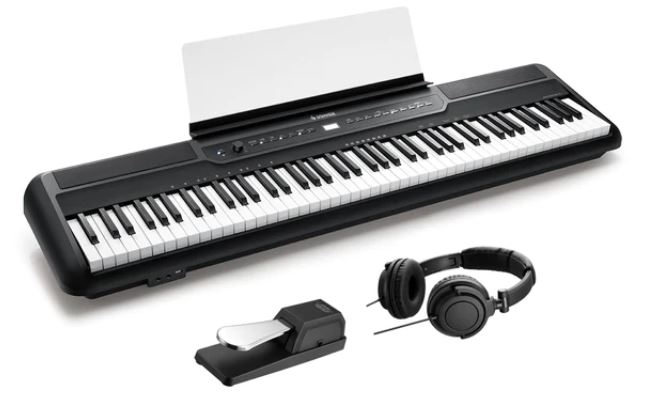
There are 3 models in the Donner Oura series, the S100, S300 and R300. Now I haven’t seen the S100 or S300, but according to Donner’s website at the time of this review:
- all 3 models share the same 15 sounds, and pretty much all the same features
- they all have fully weighted & graded hammer action keys, but the S300 & R300 have “enhanced” hammer action (I’m not sure exactly what that means . . .)
- the S100 has 2x10W speakers for a total of 20W, while the S300 and R300 have 2x15W speakers for a total of 30W
Other than that, the only differences appear to be the body design with the S100 being more of a slab style with legs, while the S300 and R300 have nicer furniture style bodies that include foldable lids that can cover the keys.
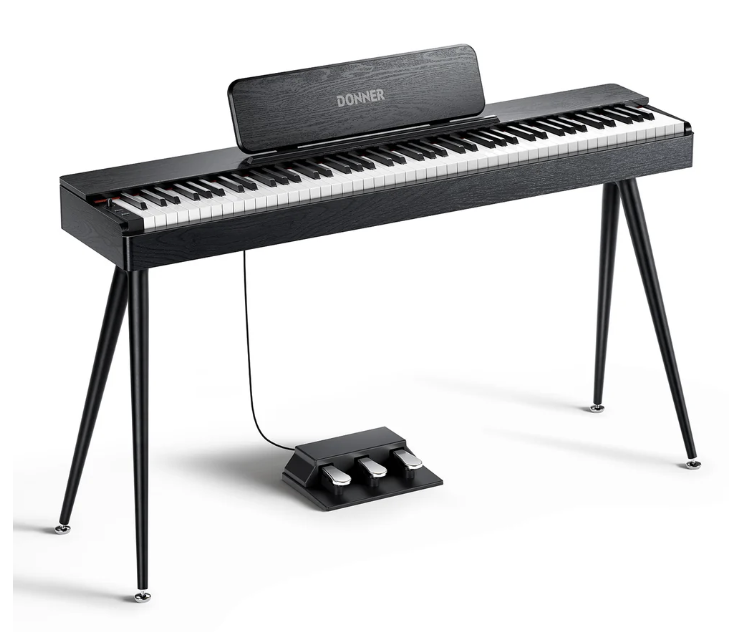
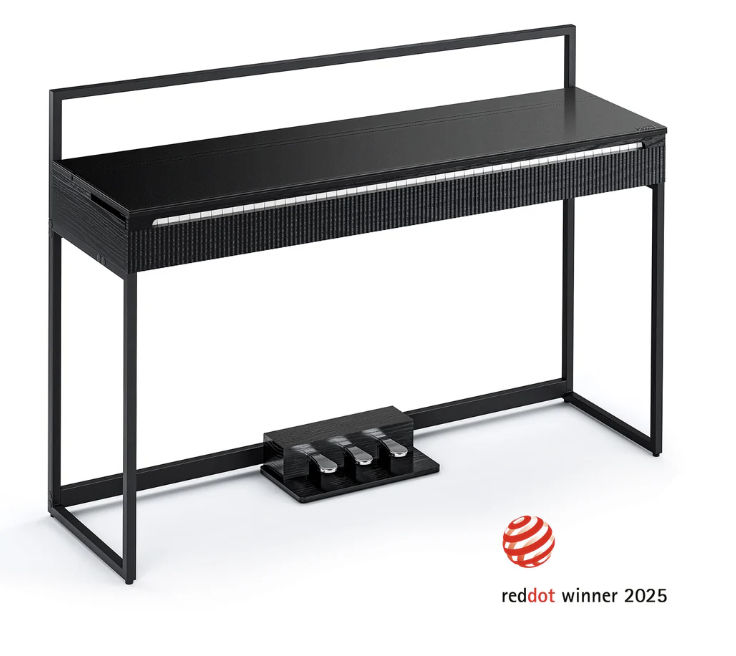
And the S100 & S300 appear to only come in black, while the R300 comes in either brown or beige (I got the brown one). Ok, so let’s get into the Donner Oura R300.
Donner Oura R300
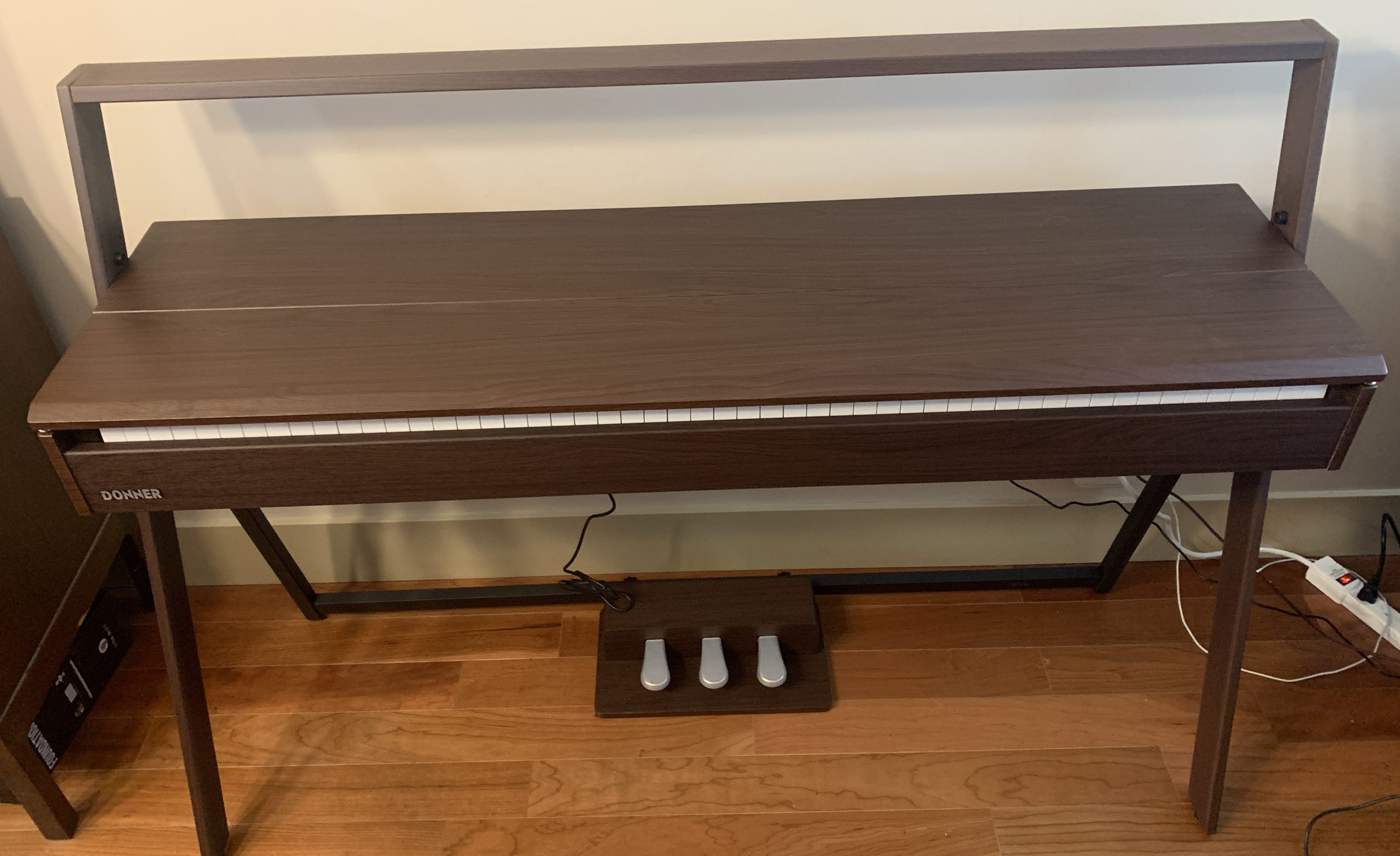
Furniture Style Body
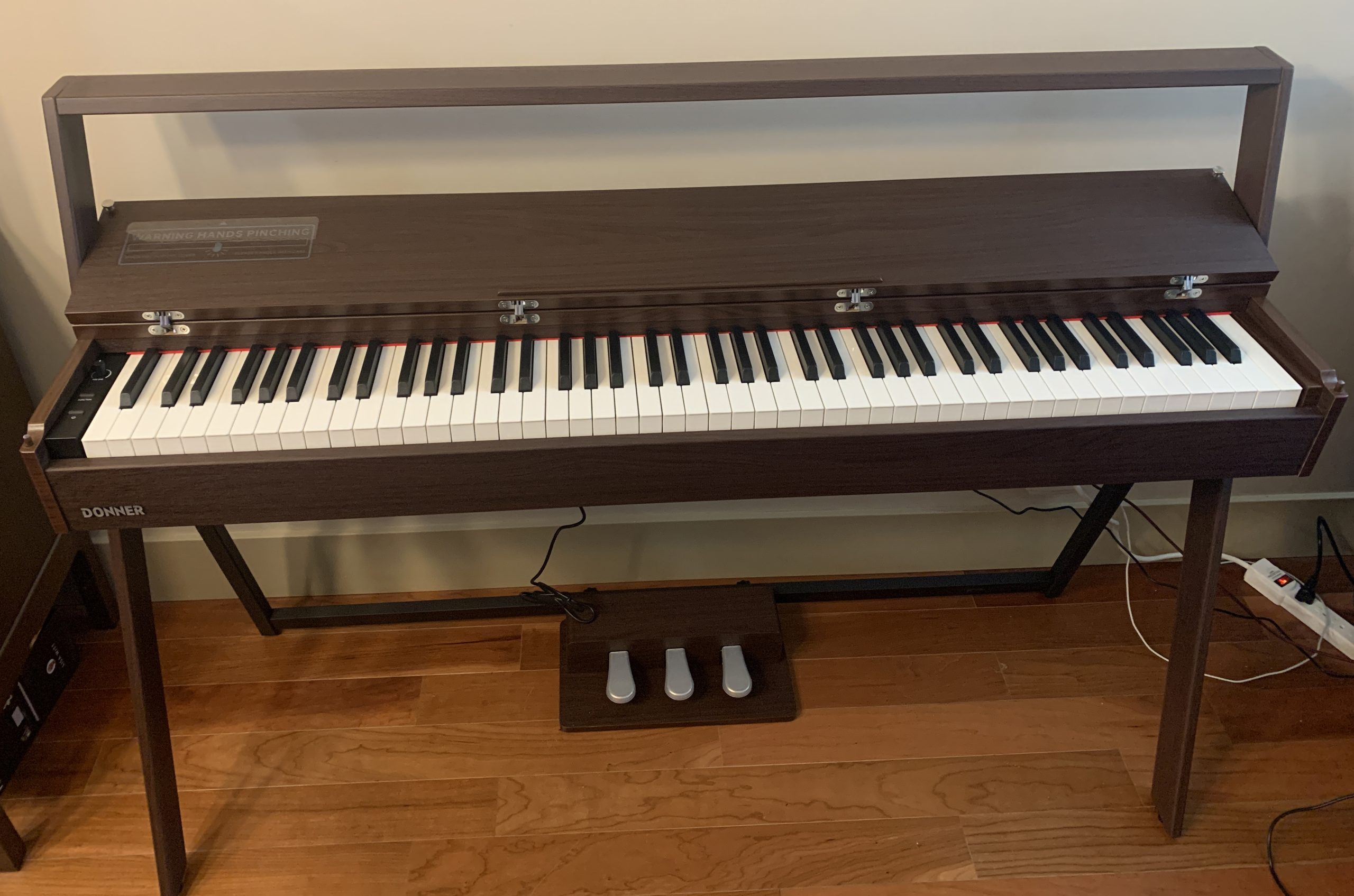
OK so I’m not the type that usually cares much about piano esthetics or looks etc, my focus is always on sound quality and functionality, but I have to admit . . . this is a really cool looking piano. This is something Donner has been doing extremely well; coming up with really creative & attractive furniture style bodies for their home digital pianos. The DDP-80 that I reviewed is a very unique & cool looking piano, and I personally like the design and look of the R300 even more, especially the colour and the folding key cover. I’m actually surprised the big players like Yamaha etc have not followed suit with these types of designs; those companies seem to be sticking with their standard formula for furniture style pianos that are intended to look like upright pianos with square / rectangular bodies.
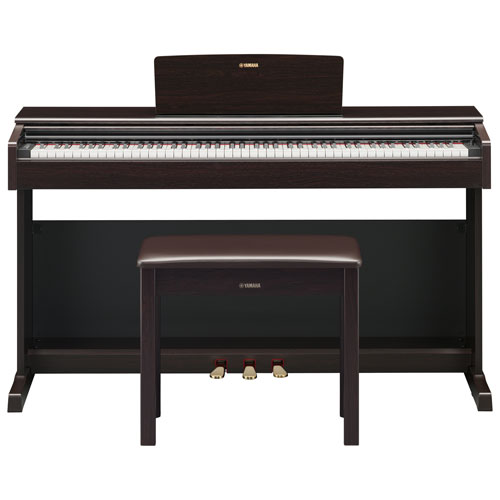
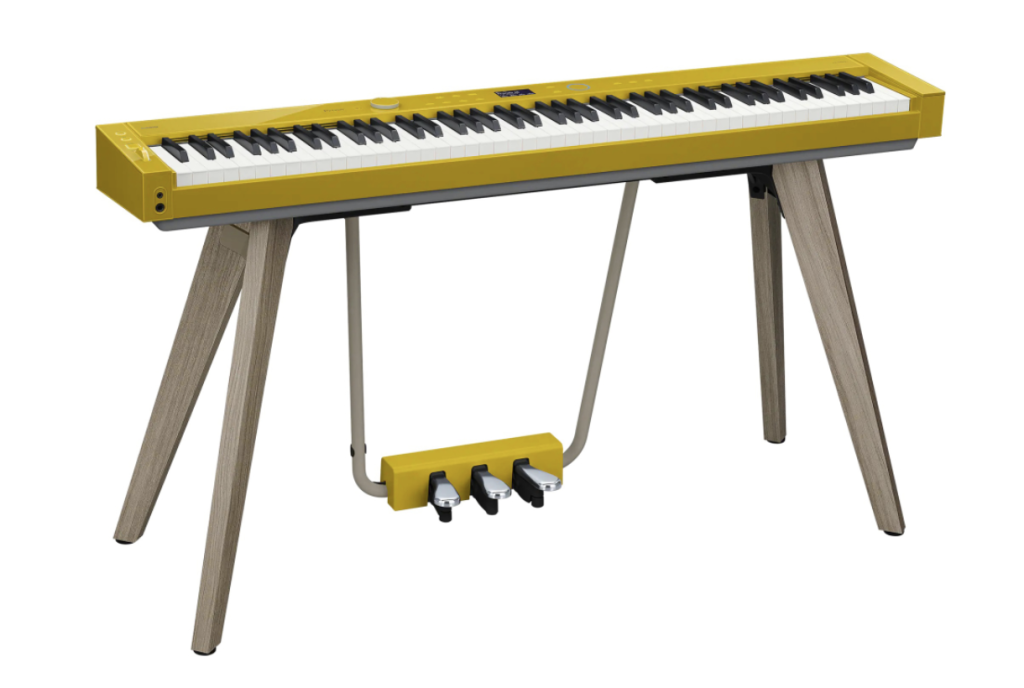
Casio is the only manufacturer that seems to have followed Donner’s lead with creative designs; their higher end Privia models that came out (after Donner’s DDP-80) have a similar design to that Donner.
The R300 is quite heavy; the box it came in was over 80 pounds. I was actually quite impressed with how sturdy and well designed it ended up being; the legs and main support for the piano box itself are metal and reasonably heavy duty. And the assembly was pretty straightforward; and now that it is assembled, it is a very solid and steady feeling piece of furniture. And something else to note is how compact the piano is depth wise at only about 14″ deep; the Yamaha DGX-670 I owned for a couple of years (which is technically a portable piano not a furniture style) was about 18″ deep.
Something else to quickly talk about is the folding lid; when closed it not only helps keep dust out of the keys, but now you can use the piano almost like a table (for me, I may even occasionally have a light portable keyboard sitting on top of it for a review). And when it’s open it can act as a music rest, but . . . I think Donner should make a couple of subtle changes here. In my opinion, it lies too flat to easily view a music book or tablet – and if the design was modified to allow it to rest at a better angle, it would also need a wider rest at the bottom to hold your music.
Key Action
Ok so that’s enough about how pretty the R300 is; let’s get into the actual piano features. The first one I want to talk about is the key action. The Donner Oura R300 has 88 fully weighted and graded hammer action keys (which Donner calls their “Enhanced Hammer Action”), so the keys on the left feel heavier than the keys on the right. The white keys have a smooth finish, but I definitely noticed that they don’t feel as “slippery” as other smooth finished white keys often do; I have no idea why that is (possibly some kind of anti-slip coating?), but they do feel a bit better than what I expected. And the black keys have a subtle but comfortable feeling matte finish on them, so overall I quite like how these keys feel.
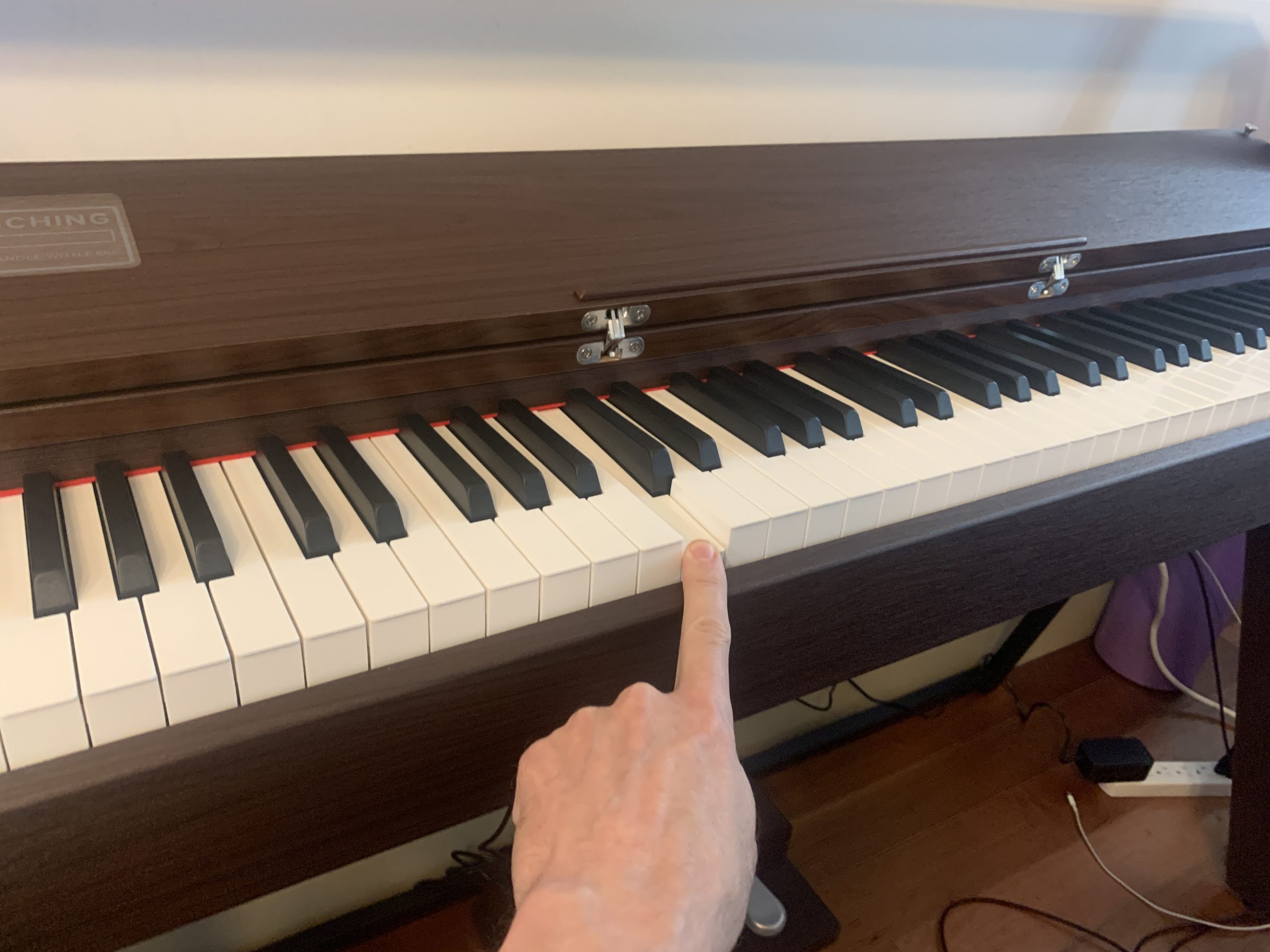
But how is the action? Right off the bat I have to say I was REALLY surprised at how good this key action is. The key actions on the DDP-80 and SE-1 were both fine; I found the DDP-80 action to be a bit on the heavy side and the SE-1 to be a bit on the light side. While I don’t have those available to compare directly to the R300, from memory I would have to say that the R300 lands somewhere in the middle as far as how heavy the keys feel. But more importantly than that, they feel MUCH nicer to me to play than how I remember the DDP-80 feeling or especially the SE-1. They are smooth, comfortable, and quite nice to play, and while the main piano sample doesn’t seem to have TONS of dynamic variation to the sample itself, the action does allow you to control your dynamic volume quite well. The key depth feels good, and these keys must have a long pivot point, because they don’t feel significantly harder to play as you play into the keys, so great job there Donner.
Sounds
There are 15 sounds on the Donner Oura R300, and an impressive 256 notes of polyphony. There is however, no ability to layer or split voices, but thankfully there are a couple of pre-layered voices. The voices include the main Concert Piano voice, a Grand Piano, a couple of pre-layered voices (Piano With Strings & Piano With Electric Piano), 3 electric pianos, a jazz organ, a couple of strings voices, a cello & a violin then a guitar and a bass; the bass is a strange thing to have included when you can’t split that with a piano (I would have preferred to have seen a pre-split bass & piano option).
The main Concert Piano voice is by FAR the highlight on the Donner Oura R300. It sounds really good, especially through headphones; the lows resonate nicely, and the highs are nice and clear. As far as where it lies on “Piano Tone’s Sound Spectrum” with Roland piano sounds being deep & woody with emphasis on the low end and Yamaha pianos sounding bright and crisp, I’d say the Donner Oura R300’s main voice lands somewhere in between. As I mentioned in the key action section, I’m personally not hearing a TON of variations in the piano sample itself when you play with different dynamics, BUT there are SOME variations, and the sample volume responds perfectly to my changes in dynamics. So for a piano that (at least in most markets) sells for considerably less than furniture style models from the big name competition, this piano sample is awesome.
Given how much I liked the main Concert Piano voice I was a bit surprised at how unimpressed I was with the “Grand” Piano voice; I’m not an effects specialist by any means, but this voice to me sounds more like a piano with a ton of chorus effects added (which in my opinion make it sound more like a honky-tonk piano). But as I always say, voices are totally personal, so you may have different opinions than I do. But, if your main concern regarding the R300 is “will the main piano sound good?”, then I’m confident in saying you’re likely to be totally happy with it.
Now as far as the rest of the sounds go, they’re mostly OK and can be fun to have for a change of pace – there IS a good selection of bread and butter voices here. But to be honest none of them are anything special; I would probably only use the main piano voice virtually of the time, but that’s ok by me, for an instrument like this, that IS the voice that actually matters. The pre-layered piano & strings and piano & electric piano voices are probably the only other voices I would ever use, they’re both nice options for filling out a ballad, and both of the layered voices are nicely balanced with the pianos so they don’t overpower the piano. And if you’re an organ fan, while it is nice that there IS a jazz organ voice, I would NOT recommend trying to do a palm smear on a fully weighted action with piano shaped keys – it might smart a bit.
Here’s a demo of all 15 voices, but I will spend most of my time on the main Concert Piano voice.
User Interface
The user interface on the Donner Oura R300 is extremely basic; EVERYTHING is done with key combinations (including selecting voices), by holding down the Function button (which is the only button there is :). Now I’m NEVER a fan of user interfaces that require key combinations (ESPECIALLY for selecting voices), but apart from voice selection, there are actually VERY few functions that are even available so to be honest, for a piano that’s meant to be used at home as opposed to on stage; this really isn’t the end of the world. And since I’m likely to be using the main piano voice (which is the default) 99% of the time, the other voice keys don’t really matter to me.
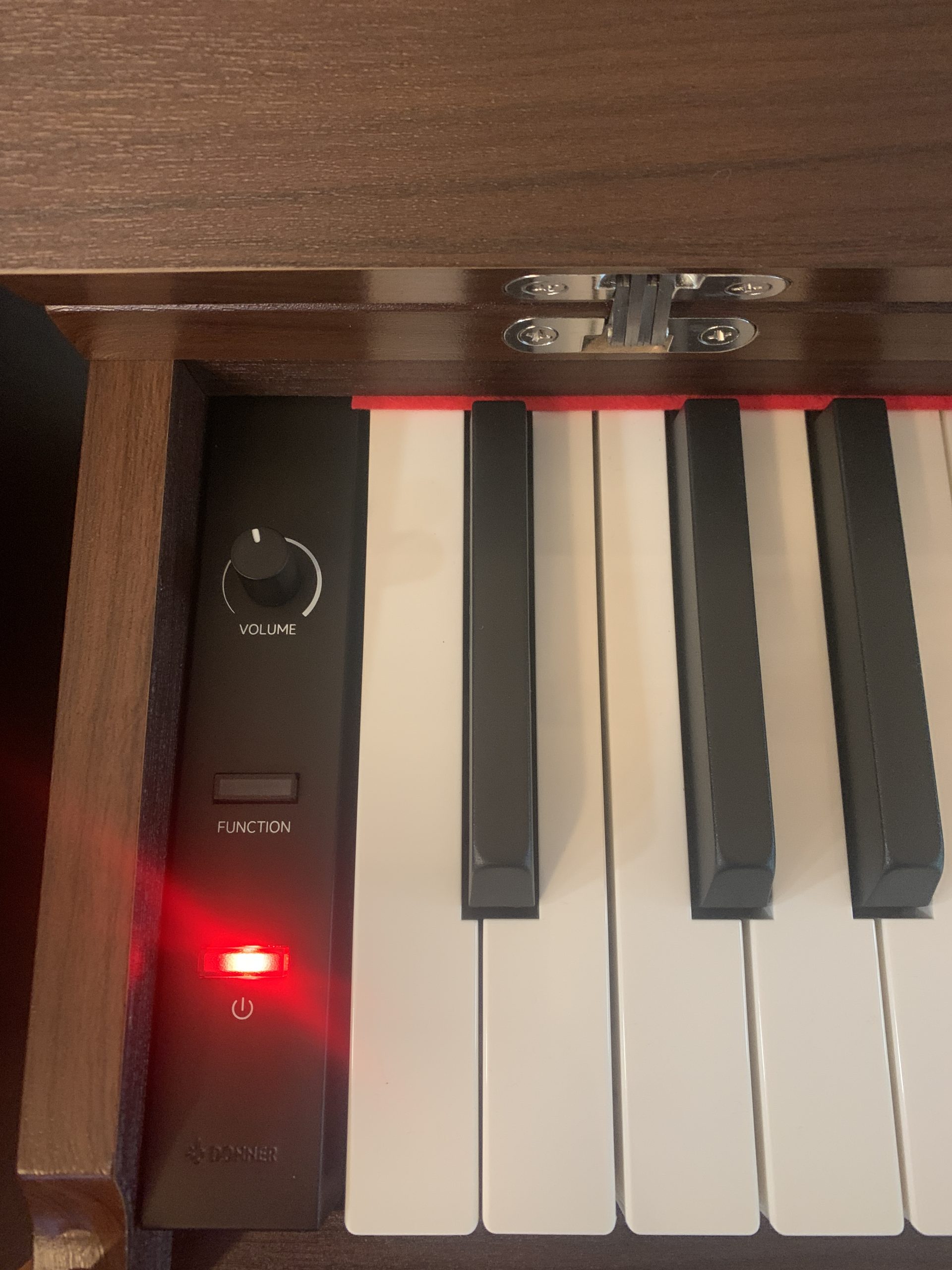
The first 15 keys are used to make your voice selections, then there are some keys on either side of middle C that are for transposing, then beyond that we have keys for playing the 3 built in demo songs (which I will NEVER bother with), and then all that’s left is keys for turning local control and BlueTooth on or off. And I already have the “BlueTooth ON” key memorized (it’s the highest B on the piano) because it turns out that the piano won’t automatically connect to prior BlueTooth devices when it’s turned on – you have to manually trigger the pairing every time.
Now I should also mention there is a confusing clear sticker included, that I THINK is intended to be peeled off and stuck to the inside of the lid when it is flipped open to help you find key combinations, but . . . it’s kind of strange. The top half shows you key combinations, which would be great EXCEPT the individual voice NAMES aren’t included on this (just the range of keys for all the voices, which isn’t all that helpful). And I have no clue what the bottom half is even for; there is a big bold “L”, “M” and “R” set of labels (maybe “left, middle and right”? still no clue . . .), and if you peel off the bottom half, the label includes long rectangular holes . . . I must be missing something here. And, if you wanted to use the top half, you would have to manually cut it off from the bottom half because it’s all one big label (that if you don’t cut actually won’t fit on the lid). I’m wondering if this label was meant for a different model with a bigger lid and the same key combinations . . . If the voice names were on this I would probably cut off the top half and use it, but since they’re not, I’m not going to bother.
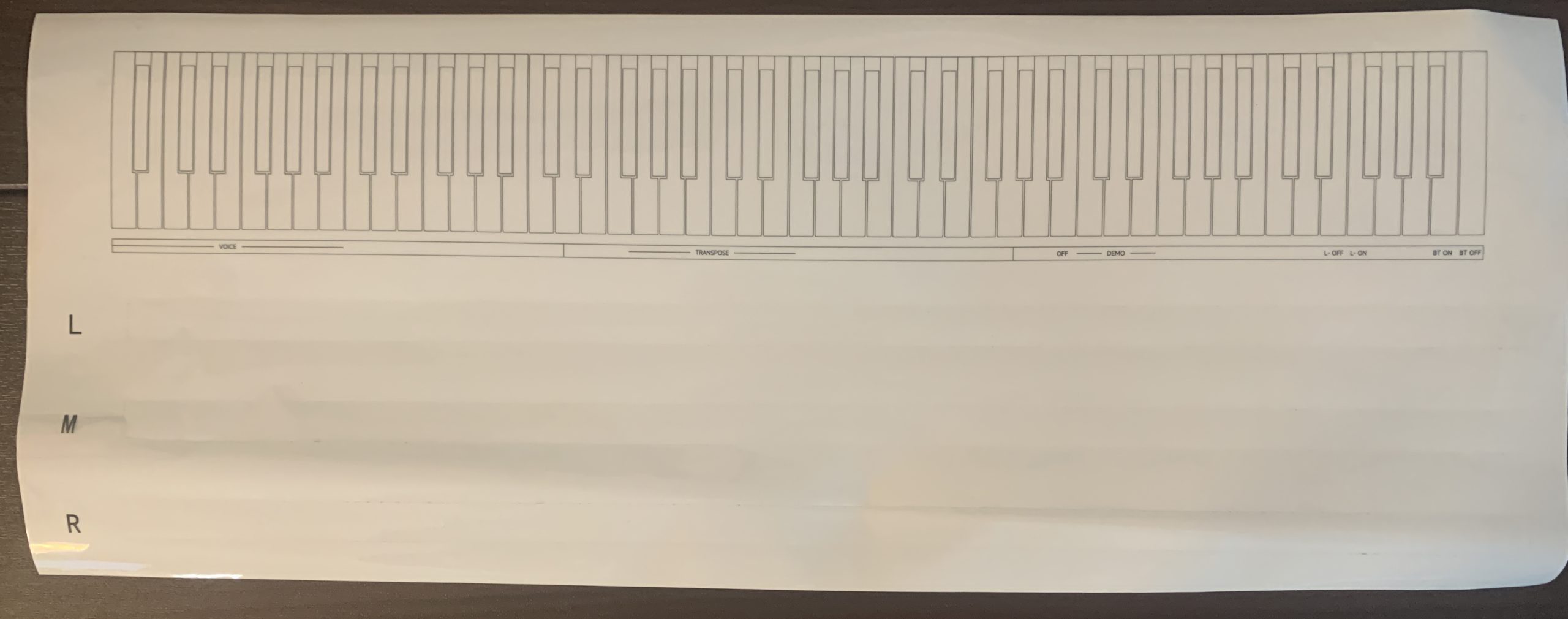
So the verdict on the user interface? It’s super basic, and like I said that’s not the end of the world for me since this is a home piano, and I’m also VERY likely to turn the R300 on, MAYBE hook up a BlueTooth device, then play the main piano voice and then turn it off again and that’s it? I’m fine with it. That being said, Donner really should have just either labelled the keys (including the voice names) or at the very least included the voice names on that sticker so you don’t have to memorize them or look them up.
Connectivity
For connectivity on the Donner Oura R300, we have the following:
- two 1/4″ stereo headphone ports on the front left underside of the piano, which is much preferred to being on the back
- triple pedal port for the included triple pedal unit (this port is also on the bottom of the piano)
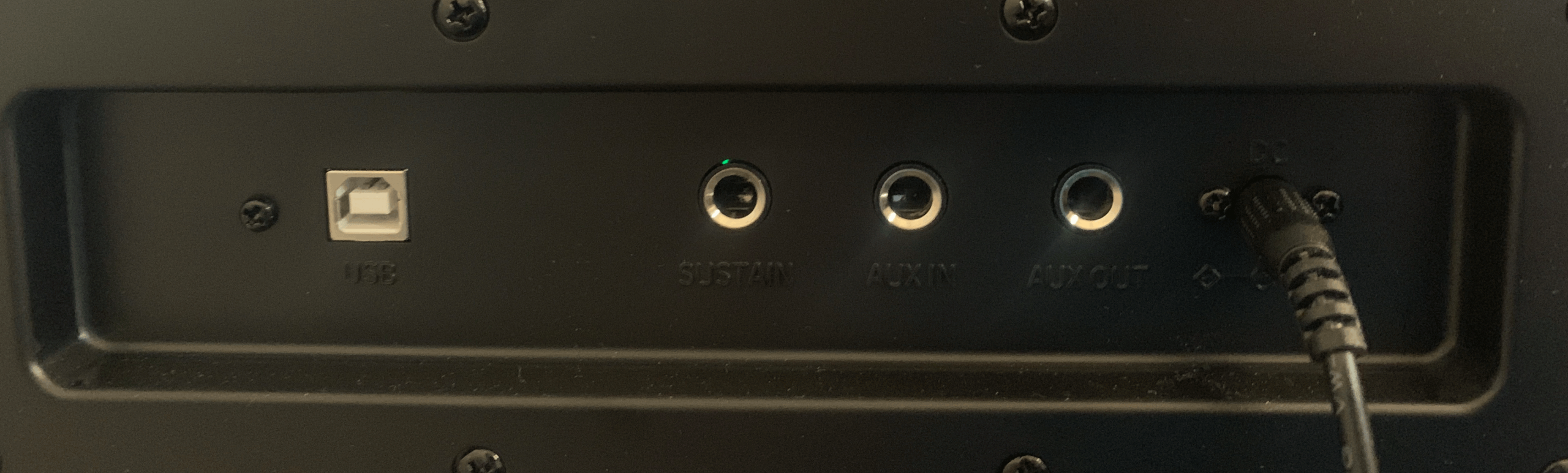
Then on the back, we have a couple more items:
- USB to host port: This is for sending MIDI to an app on a device (like a sound bank app, or DAW app like GarageBand etc); NOTE: I have seen some reviews online that claim that this port transmits both MIDI AND Audio, which IS a great feature but . . . THIS PORT DOES NOT TRANSMIT AUDIO IT IS MIDI ONLY!
- 1/4″ Auxiliary IN port: You can use this to stream audio IN to the piano, or better yet:
- BlueTooth Audio IN: you can stream external audio in to the piano with a BlueTooth connection to your device (NOTE: As I mentioned previously, you DO have to manually turn on BlueTooth to pair with your device every time you turn the piano on)
- BlueTooth MIDI: The R300 also has BlueTooth MIDI (note that you may not see the R300 as an option in your device’s BlueTooth settings; you may need to set this up within an app like GarageBand); the lag is actually pretty bad though, so I would never both with this myself
- 1/4″ Audio Out: this is for connecting to external audio equipment; I’m ASSUMING this is a summed L&R mono out but the specs don’t specify that; it’s a shame there aren’t separate L&R line outs, but given that this isn’t a stage piano, that’s not that big of a deal
- 1/4″ Generic sustain pedal port: if you prefer to use a 3rd party sustain pedal instead of the sustain on the built in triple pedal unit you can connect that here
So overall, the connectivity isn’t bad (especially for a home piano) – it is a bit annoying that you have to manually reconnect BlueTooth audio every time you turn the piano on, but you memorize that function key pretty quick and it only takes a second so not the end of the world.
Speakers
The speakers on the Donner Oura R300 are pretty good; they are 15W per side for a total of 30W, & they’re downward facing; I typically prefer upward facing speakers but that preference applies more to portable plastic pianos as opposed to a heavier furniture style. With the larger and heavier case on a piano like the R300, downward facing speakers can get a nice boost to the lower end. They get pretty loud and do a great job of capturing lows, and an . . . OK job of capturing the highs (while they do get loud, you will definitely notice a big difference in the high end of the EQ range when you listen through headphones). They’re not the best speakers I’ve ever heard, but they’re not the worst either, and are more than loud and clear enough to easily fill a room in your home.
Here is a quick demo on the speakers, just as picked up by my iPhone’s built in mic.
Other Features
So what about registration memory, onboard recording features, rhythms and accompaniment, custom effects or any other features you often see? Well . . . the R300 doesn’t have any of that so there’s nothing to talk about, but to me that’s totally cool; for a product that’s MEANT to be a home piano, just like the Donner DDP-80, I actually PREFER not having to worry about extra features like that. Since I’ve had this set up in my living room, I’ve actually started working on my piano lessons on the R300 instead of on my new Yamaha PSR-SX720 keyboard I use with my band. And why is that? Well truth be told; I often load up my piano lessons with that Yamaha, and then find myself getting distracted and cut my lessons short to work on band songs. With the R300, I load up my lessons on my iPad, turn on the R300 and connect the BlueTooth audio, and use the main piano voice to get working on my lessons without any distractions.
I should also mention “as a feature” that the R300 includes a triple pedal unit, so you do get sustain, soft & sostenudo pedals just like on a real piano, and that the sustain is compatible with half pedaling which is awesome. Note that if you use a 3rd party sustain pedal in the extra sustain pedal port that this one will NOT be compatible with half pedaling.
Software Bundle
Something to mention that is currently being offered wiith the Donner Oura R300 is a software bundle; at the time of this review, that includes:
- Cubase LE: this is the “light” version of the popular Cubase DAW recording and mixing software
- Wavelab LE: this is for audio editing & mastering
- Cubasis LE: this is a version of Cubase LE that runs on mobile iOS & Android devices
- Melodics: you get 40 free lessons on the Melodics training app
What’s Missing Or Could Be Improved?
For what the Donner Oura R300 is meant to be (which is an attractive furniture style piano for the home), I think it’s a great package. It has a sturdy & attractive case, a surprisingly good key action, and a pretty good main piano voice, decent speakers and BlueTooth audio in to play along with songs, backing tracks or online piano lessons. All those missing “Other Features” that I mentioned aren’t really needed in a product like this, and adding them will just bump up the cost.
That being said, I will mention a few things that I would really like to see:
- reduce the number of voices (maybe even to just ONE piano voice like the DDP-80) and then try to enhance that main voice even more (it’s already pretty good but I think it could be even better with more sample changes to match your dynamics)
- if the voices aren’t reduced in number, replace the 2nd Piano with a new sample, and replace the bass guitar with a pre-split bass & piano, AND either label the keys with voice names, or at least fix the included sticker to include the voice names
- modify the folding lid to sit a better angle for viewing music with a book or a device (which would also involve a thicker ledge for the music to rest on)
- add an audio interface to the USB to host port (this would offer a bunch of new functionality, especially making it easy to record high quality piano videos)
Competition, Alternatives & THE VERDICT
When you’re looking specifically at “furniture style home digital pianos”, apart from other “Amazon only” brands that seem to be popping up (that have strikingly similar bodies and cases), you’re basically looking at offerings from Yamaha, Roland, Kawai, Korg and Casio, all of which will tend to be the more traditional furniture style that is meant to look like an upright piano. So to be clear, for this comparison, I am NOT including plastic portable digital pianos that happen to be sitting on a basic wooden stand like a Yamaha P-225 on a wooden stand; I am only comparing the Donner Oura R300 to actual furniture style models from other manufacturers.
So how does the Donner Oura R300 compare to the entry level options from the more established brands? Apart from the esthetics and body design (which is totally a matter of personal taste, and to be honest I actually prefer the look of the Donner Oura R300 to the more common upright piano look), I think the key action on the R300 IS actually comparable and possibly even better (at least initially) than entry level actions on pianos like the Yamaha Arius YDP-145, which uses Yamaha’s well known entry level GHS action. But I can’t offer any opinion on how well the Donner action will hold up over time, while I can say from personal experience that Yamaha’s GHS action is a great build quality.
So apart from the esthetics and key action? While Donner’s sounds and other features are pretty good, they aren’t quite on par with the bigger brands, so it basically comes down to pricing, and that’s where my recommendation totally depends on what the relative prices are where YOU happen to be. There has always been a bit of inconsistency between brand pricing from location to location (for example where I live, Roland has always been significantly more expensive relative to Yamaha than they are in the USA). But lately, these inconsistencies have become far more unpredictable.
For example, where I live, right now the Donner Oura R300 sells for about $650USD, and the Yamaha Arius YDP-145 sells for about $1100USD, but in the USA, the Donner Oura R300 is selling for $800USD and the Yamaha is $1000USD, which is suddenly getting much closer in price. So when you are trying to make your buying decision, you really need to take a close look at prices where you are to decide if the R300 is saving you enough money over the more established brands.
In my opinion, the Donner Oura R300 shouldn’t be more than 3/4 of the price of something like the Yamaha Arius YDP-145
Donner Oura R300: THE VERDICT
So if you’re looking for a unique and attractive furniture style piano that will look good in your home, has a surprisingly good key action, a pretty good main piano sound, speakers that sound good and will easily fill a living room and the convenience of BlueTooth audio in, then as long as you’re ok with the pricing issues I mentioned earlier?
I can totally recommend the Donner Oura R300!
So if you want to check out current prices in your area for the Donner Oura R300 or any of the other products I talk about in this review, please check out my affiliate links below.
Thanks so much, and happy piano playing! (and piano shopping 😉 )
I have included links below so that you can check current pricing from Donner via Amazon or direct from their website:
Donner Oura R300 (Amazon USA): https://amzn.to/4ricwM5
Donner Oura R300 (Amazon CAN): https://amzn.to/4iooUpX
Donner Oura R300 (Donner Website): https://bit.ly/3JVBXT6 (Use my code ‘TONE’ to get 12%-15% off!)
Video Version Of This Review
Piano Training I Recommend
I’ve taken a number of online piano courses and tried various piano learning apps; the ones I’m listing here are my favorites and I can highly recommend any of these if you are looking for some online training to get started on learning piano, or to take your current skills to the next level.

Bird’s Piano Academy is one of my absolute favorite online piano programs. Arthur Bird has created multiple courses on getting started learning piano quickly as well as great intro courses on Blues, Jazz and more. And his courses are chord based, so you don’t have to read sheet music which is AWESOME and definitely the fastest way to learn to play modern music. You can go with a subscription that includes ALL his courses, or you can buy individual courses a la carte with LIFETIME access – HIGHLY RECOMMENDED!

If you’re looking for the least expensive way to get started on piano, Pianoforall is a great option. It’s a unique course created by Robin Hall that uses downloadable eBooks with embedded videos and audio instead of a website.
This course is an amazing option for learning piano from beginner up to being able to perform; it teaches multiple genres of music and focuses on how to be a “one person band” on the piano. This course is taught by pro pianist Steve Lungrin – Steve has been teaching and performing his whole adult life and is a fantastic instructor and performer.
I took this course from 2020 to 2021 and it elevated my playing from a very basic level to being able to play songs in multiple genres.
I was super excited when Simply Piano added the “Chords Path” to their super popular piano training app (iOS or Android); this path allows a new student to get started learning piano using a chords based approach (which I HIGHLY recommend over a traditional approach). Learning to play using chords is by far the easiest and fastest way to learn to play modern songs (MINIMAL sightreading ability is needed). I did the entire chords path, and can highly recommend that you check it out (you will get a trial period so why not?)

This is a fantastic option if you are mostly interested in rock music. This course was created and is taught by Marine Lacoste, who is not only a fantastic instructor & pianist, but she is also a very accomplished hammond organ player – she performs regularly with her own band, as well as playing keys regularly for multiple recording artists on tour. I started this course in 2023 when I joined a band, and it is helping me greatly in taking my playing to a new level. And Marine is constantly adding new content, and is very active on the platform.
If you sign up for Online Rock Lessons yearly subscription, use code PIANOTONE at checkout to let Marine know I referred you, and she will give you some free bonuses!

This is a fantastic (but pretty unique) online program for taking your piano and organ playing skills to the next level, developed by pro piano, keyboard & Hammond organ player Mike Little. Mike shares tips & tricks accumulated from over 30 years of pro touring, gigging, studio & production experiences. This course isn’t for a COMPLETE beginner, but you don’t have to be a super accomplished player either, to get TONS of value from this program!

Ultimate Piano isn’t an actual course to learn how to play, but it IS a really helpful TOOL for piano students. You connect your keyboard to your computer, go to Ultimate Piano’s website (so NOTHING to install!) and you have a ton of helpful training and exercises at your disposal, as well as built in piano sounds. With the help of on screen light up keys, you can learn and practice scales, chords and even ear training and you can play along with MIDI or audio files, and even YouTube videos to practice songs!